
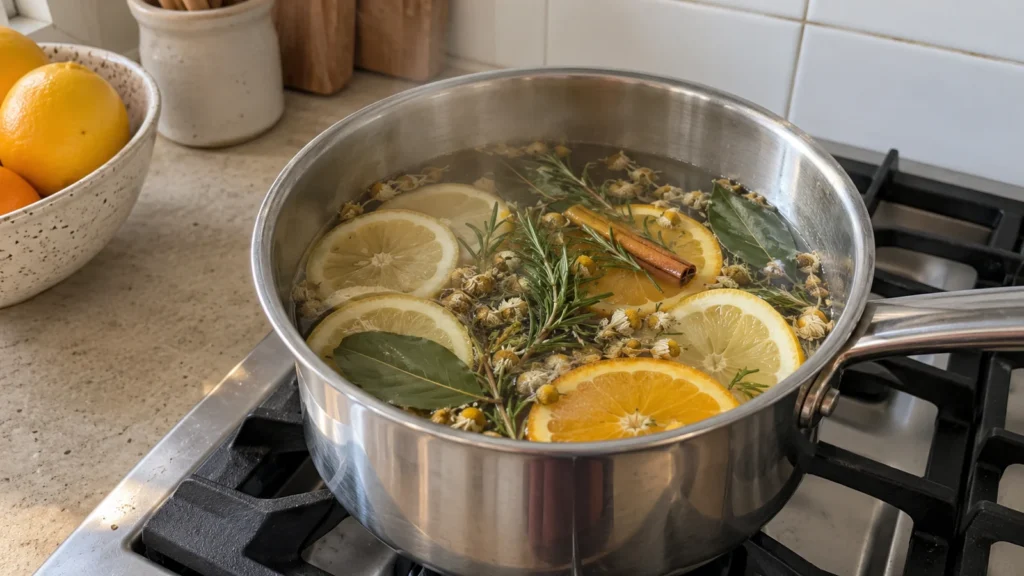
This Imbolc simmer pot recipe creates a bright, herbal home fragrance that captures the transition from winter to spring. Fresh lemon and rosemary provide the main scent, while orange, chamomile, bay leaves, vanilla, and a touch of cinnamon add softer botanical notes and gentle warmth.
Unlike heavily spiced winter simmer pots, an Imbolc blend should feel fresh, green, and light while retaining a little seasonal warmth. Use the recipe card below for the exact ingredients, quantities, and stovetop instructions. This guide explains how to balance the fragrance, customize the ingredients, use the simmer pot safely, and understand its connection to Imbolc.
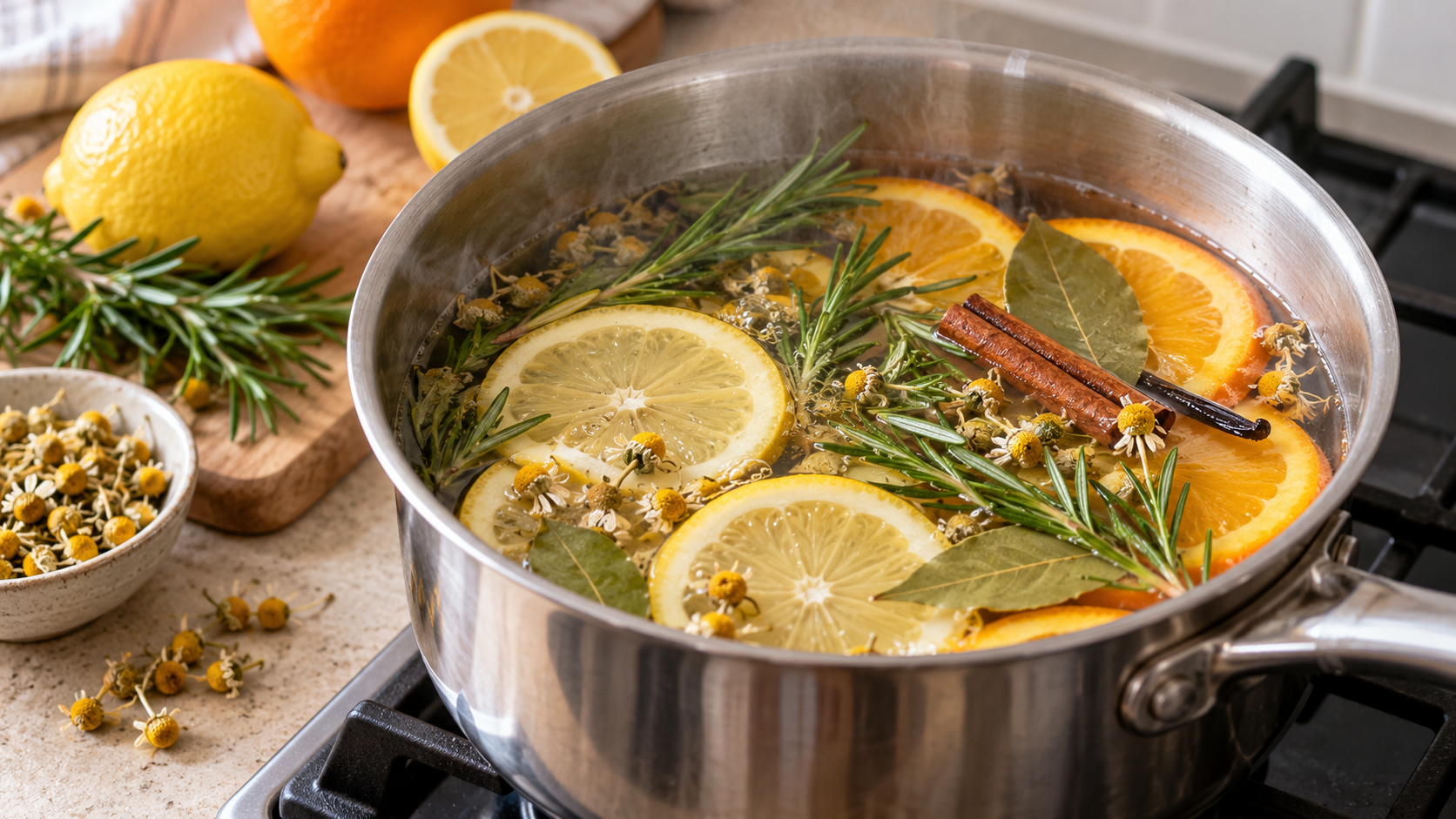
Imbolc Simmer Pot Recipe With Lemon and Rosemary
Ingredients
Equipment
Method
- Wash the lemon, orange, and fresh rosemary, then thinly slice the lemon and orange.
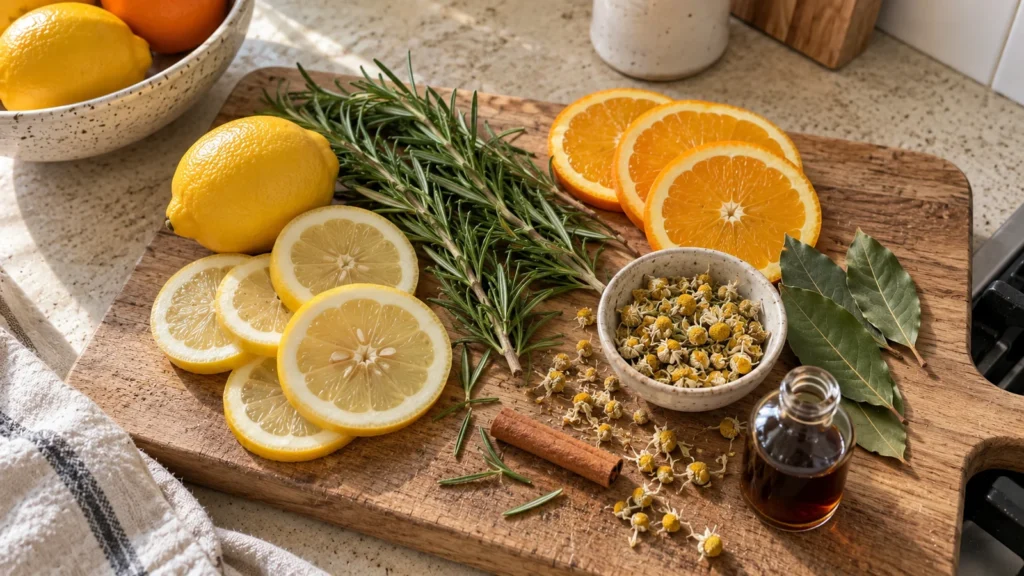
- Add the lemon, orange, rosemary, chamomile, bay leaves, and cinnamon stick to a 3-quart saucepan.
- Pour in 6 cups of water and stir in the vanilla extract.
- Heat over medium heat until gentle steam and small bubbles appear.
- Reduce the heat to low and maintain a gentle simmer.
- Check the water level every 20–30 minutes and add more hot water whenever needed.
- Adjust the fragrance if needed by removing some rosemary for a lighter herbal note or adding fresh lemon peel for more brightness.
- Turn off the heat when finished and whenever you cannot supervise the saucepan.
Notes
What Should an Imbolc Simmer Pot Smell Like?
An Imbolc simmer pot should smell bright first, green second, softly botanical in the middle, and lightly warm at the end.
Lemon should be one of the most recognizable notes. Rosemary provides the fresh herbal character that connects winter with the beginning of spring. Orange and chamomile soften these stronger fragrances, while bay leaves, vanilla, and cinnamon remain in the background.
The ideal fragrance balance follows this order:
Lemon → Rosemary → Orange → Chamomile → Bay → Vanilla → Cinnamon
This fragrance hierarchy matters more than being able to identify every ingredient individually.
- Too much cinnamon: The simmer pot begins smelling more like Christmas or a traditional winter blend.
- Too much rosemary: The herbal fragrance overpowers the citrus freshness.
- Too many floral ingredients: The mixture moves closer to a general spring simmer pot.
The goal is a fragrance that feels fresh, green, soft, and gently warm, rather than overly sweet, spicy, or festive.
How to Balance an Imbolc Simmer Pot
If your simmer pot doesn’t smell quite right, avoid adding several ingredients at once. Small adjustments make it easier to maintain the intended fragrance.
Follow this simple method:
Observe → Identify → Correct → Wait → Recheck
Move away from the immediate steam for a moment, while keeping the stovetop supervised, before evaluating the fragrance again. Constant exposure can make a scent seem weaker than it actually is.
If It Smells Too Much Like Christmas
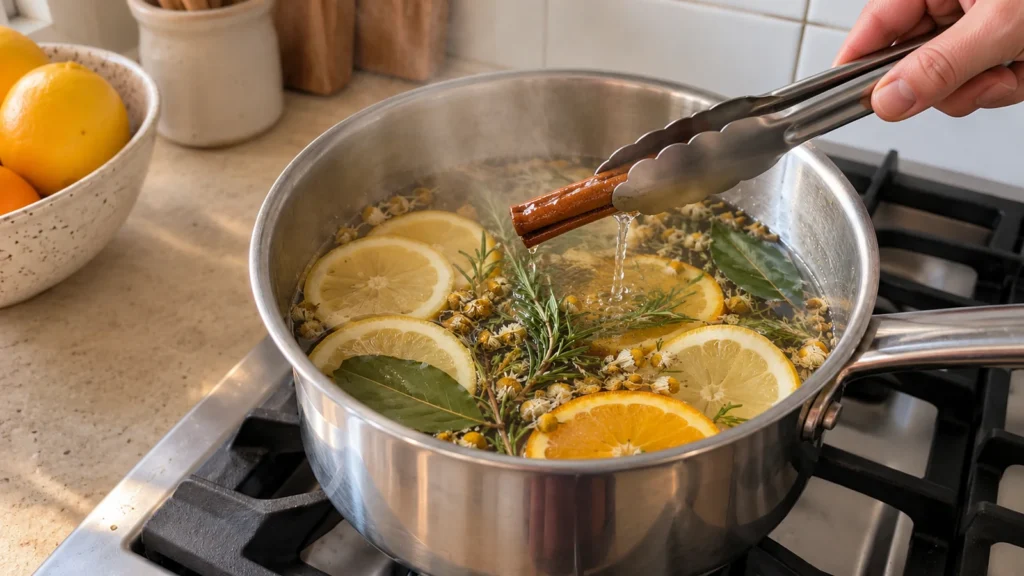
A strong cinnamon or sweet orange fragrance can make an Imbolc simmer pot smell more like a winter holiday blend.
Remove the cinnamon first, add a little more water if necessary, and allow the fragrance to settle. If the mixture still feels too warm or sweet, strengthen the fresh citrus notes with a little lemon.
Avoid allowing the following ingredients to dominate:
- Cloves
- Star anise
- Cranberries
- Several cinnamon sticks
- Large amounts of orange
These ingredients work well in winter simmer pot recipes, but too much of them reduces the fresh character that makes an Imbolc blend distinctive.
If It Smells Too Herbal
Rosemary is usually the first ingredient to check when the fragrance becomes too herbal.
Remove part of the rosemary and allow approximately 10 minutes before making another adjustment. Avoid adding several new ingredients immediately, as this makes it harder to identify what improves the scent.
If It Smells Too Weak
A weak simmer pot fragrance doesn’t always mean you need more ingredients.
Before changing the recipe, check the following:
- Is the water producing gentle steam?
- Has the simmer pot been heating long enough?
- Are the citrus fruits and herbs fresh?
- Is strong ventilation carrying the fragrance away?
- Is the room unusually large?
Once you identify the cause, make one small adjustment and allow enough time to notice the difference.
If You Want a Lighter Blend
Reduce the sweet and warming ingredients before changing the citrus or herbs.
Keeping lemon and rosemary as the main notes preserves the distinctive Imbolc fragrance while making the overall mixture fresher and lighter.
When Should You Make an Imbolc Simmer Pot?
January 31 and February 1 are natural dates for making an Imbolc simmer pot when following the traditional seasonal calendar.
February 1 is associated with Imbolc and St. Brigid’s Day and traditionally marks the beginning of spring in the Irish seasonal calendar.
However, the traditional date and the actual weather do not always align, particularly for people living outside Ireland.
There are two practical approaches.
Follow the Traditional Calendar
Prepare your Imbolc simmer pot around February 1, even if your local weather still feels wintry.
This approach emphasizes the historical and cultural significance of the festival rather than the temperature outside.
Follow Your Local Season
If you mainly use simmer pots to reflect seasonal changes in your home, prepare this blend when your region begins transitioning from colder weather toward spring.
This approach can be especially useful for people in different climates or the Southern Hemisphere.
The important distinction: February 1 has traditional significance, but February does not represent the same physical season everywhere.
What Is the History Behind Imbolc?
Imbolc, also spelled Imbolg, is associated with February 1 and is one of the traditional Irish quarter days. It is connected with the seasonal movement toward spring and later became closely associated with St. Brigid’s Day.
Historical traditions surrounding this period include:
- Making St. Brigid’s crosses
- Preparing special seasonal meals
- Household and farm protection customs
- Visiting holy wells
- Brat Bríde traditions
- Biddy or Brídeog customs
- Customs involving livestock, crops, fertility, and the coming agricultural season
These traditions help explain the cultural background of Imbolc and its connection with renewal and the approaching spring.
However, the simmer pot itself should be understood differently.
There is no strong historical evidence that simmering lemon, rosemary, cinnamon, and similar ingredients on a stovetop was an ancient Imbolc tradition.
An Imbolc simmer pot is more accurately described as a modern seasonal home-fragrance practice inspired by Imbolc.
This distinction makes it possible to enjoy the fragrance and its seasonal symbolism without incorrectly presenting the recipe as an ancient historical custom.
Why Do Some Imbolc Recipes Mention Milk?
Milk and dairy products frequently appear in discussions of Imbolc because livestock, dairy foods, butter, and agricultural life have historical connections with the season and traditions surrounding St. Brigid.
However, this doesn’t mean milk is suitable for a home-fragrance simmer pot.
For simmering aromatic ingredients, water is generally the better choice because milk can:
- Scorch on the bottom of the saucepan
- Form a film on the surface
- Leave difficult-to-clean residue
- Develop an unpleasant cooked smell
- Spoil quickly
If dairy is meaningful to your Imbolc observance, consider including it in seasonal foods such as bread, butter, or another appropriate dish instead.
The historical meaning of the word Imbolc is also debated. Therefore, it is better not to state definitively that the word simply means “ewe’s milk.”
Imbolc Simmer Pot Ingredient Substitutions
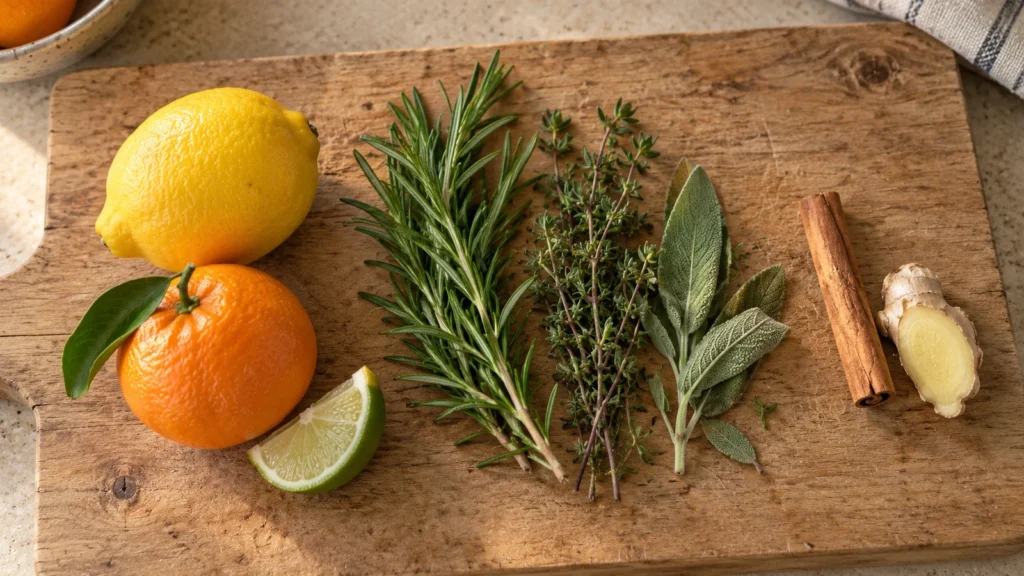
You can customize an Imbolc simmer pot using ingredients already available in your kitchen.
The key is to substitute ingredients according to their fragrance role, rather than replacing them randomly.
This helps maintain the balance between fresh citrus, green herbs, delicate botanicals, and gentle warmth.
For a Bright Citrus Note
If fresh lemon isn’t available, consider using:
- Mandarin
- Tangerine
- A small amount of lime
- Another fresh citrus peel
Lime has a sharper fragrance than lemon, so use it cautiously to avoid overpowering the softer ingredients.
For a Green Herbal Note
Rosemary provides the primary green fragrance, but you can replace it with:
- Fresh thyme
- A small amount of sage
- Dried rosemary
Fresh thyme produces a softer herbal scent, while sage can become strong quickly. Start with a small quantity and adjust as needed.
For a Soft Botanical Note
Chamomile contributes a gentle floral quality without dominating the fragrance.
Possible alternatives include:
- Culinary calendula
- A very small amount of culinary lavender
- Leaving out the floral ingredients entirely
If you don’t have a suitable botanical ingredient, omitting it is better than using too much lavender and changing the overall scent.
For a Warm Background Note
Cinnamon is optional in an Imbolc simmer pot.
You can leave it out completely for a brighter, greener fragrance. Alternatively, a thin slice of fresh ginger can provide subtle warmth without making the blend smell strongly like Christmas.
Can You Use Dried Ingredients?
Yes, dried ingredients can work in an Imbolc simmer pot.
Dried herbs are often more concentrated than fresh herbs, so begin with smaller quantities.
Fresh citrus generally provides the brightest fragrance, but dried orange or lemon can still work, especially when combined with fresh herbs.
Imbolc Simmer Pot for Different Room Sizes
The strength of a simmer pot fragrance depends partly on room size, airflow, and the type of saucepan you’re using.
A fragrance that quickly fills a small kitchen may seem noticeably lighter in a spacious, open-plan living area.
Small Rooms
Start with the standard recipe and give the fragrance time to circulate before adding extra ingredients.
Strong herbs and spices can become overwhelming in enclosed spaces, so avoid increasing quantities too quickly.
Large Open Spaces
Allow more time for the fragrance to spread before deciding whether the mixture needs strengthening.
Open windows, extractor fans, and cross-ventilation can carry aromatic steam away, making the fragrance seem weaker.
Does Pot Shape Matter?
Yes. The shape of your saucepan affects evaporation and how frequently you need to replenish the water.
- Wide saucepan: Exposes more water surface and may evaporate faster.
- Deep, narrow saucepan: May retain water longer because less surface area is exposed.
Neither shape is automatically better. The important factors are maintaining a gentle simmer and checking the water level regularly.
How Long Should an Imbolc Simmer Pot Simmer?
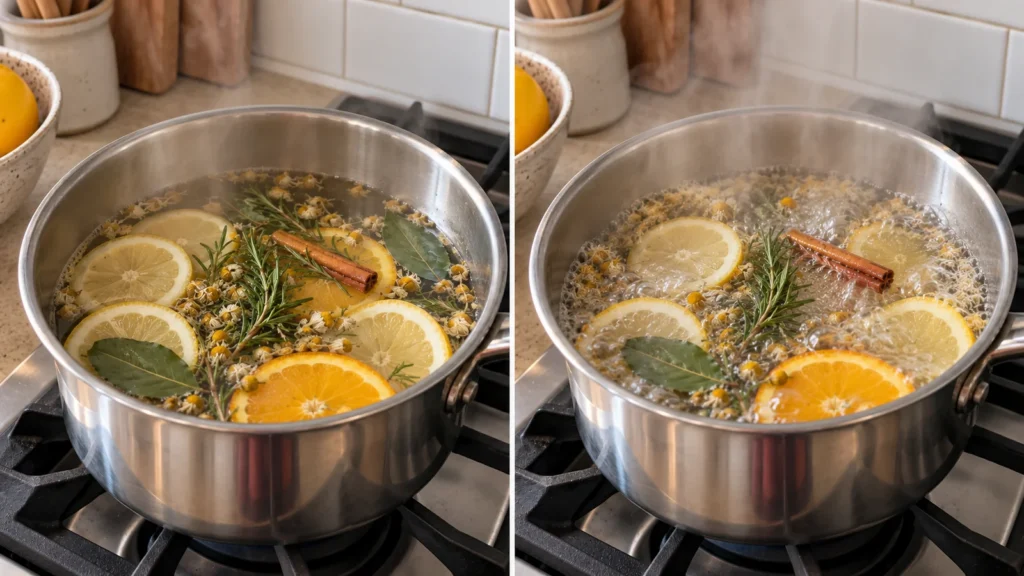
Most Imbolc simmer pot batches need approximately 30–90 minutes to develop a noticeable fragrance.
However, the exact time varies depending on:
- Room size
- Airflow and ventilation
- Ingredient freshness
- Stovetop heat level
- Saucepan shape
- Personal fragrance preference
Maintain a low, gentle simmer rather than a rolling boil. Gentle steam helps release the fragrance while reducing unnecessary water loss.
Check the saucepan frequently and add more water before the level becomes too low.
Longer simmering isn’t always better. Citrus heated for several hours can develop dull or bitter notes, while delicate herbal fragrances may gradually lose their freshness.
For the best results, keep the pot supervised and turn off the heat once you’ve achieved the fragrance you want.
Imbolc Simmer Pot Safety Tips
An Imbolc simmer pot contains hot water and aromatic ingredients, so it should be treated like any other saucepan on the stovetop.
Always maintain enough water to prevent the ingredients from boiling dry.
Follow these important safety precautions:
- Never leave the stovetop unattended while the simmer pot is heating.
- Turn off the heat before leaving home.
- Never leave a simmer pot heating while sleeping.
- Keep children and pets away from the hot saucepan and liquid.
- Check the water level frequently and replenish it when necessary.
- Ventilate the room if the fragrance becomes uncomfortable.
- Use the mixture for home fragrance only, not as a drink.
Essential oils are not necessary for this recipe. Whole citrus fruits, herbs, spices, and vanilla provide fragrance without requiring concentrated essential oils.
For complete preparation and safety instructions, follow the WP Recipe Maker recipe card above.
Imbolc Simmer Pot vs. Spring Simmer Pot
An Imbolc simmer pot and a spring simmer pot share some fresh, botanical characteristics, but their seasonal fragrance profiles are slightly different.
An Imbolc simmer pot represents the transition out of winter. Lemon and green herbs lead the fragrance, while a small amount of cinnamon or vanilla provides lingering warmth.
A spring simmer pot can move further toward:
- Fresh green herbs
- Floral ingredients
- Brighter citrus
- Lighter botanical notes
A useful way to understand the seasonal progression is:
Winter → Imbolc → Spring → Beltane
Winter blends tend to emphasize comforting spices, while Imbolc introduces freshness. Spring recipes can become greener and more floral, and Beltane blends can develop fuller floral characteristics.
This progression helps keep individual seasonal simmer pot recipes distinct.
Imbolc Simmer Pot vs. Yule Simmer Pot
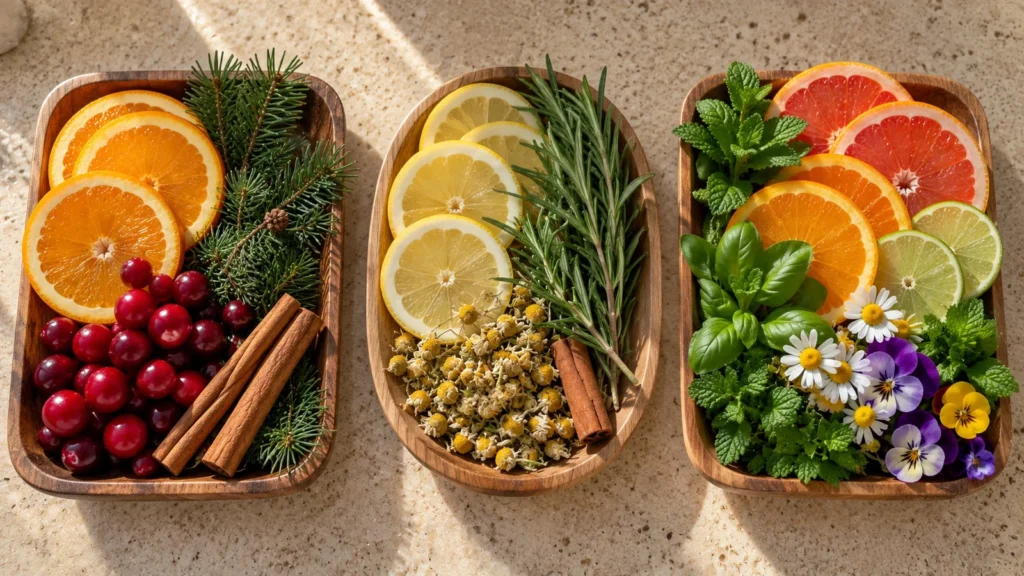
The main difference between an Imbolc simmer pot and a Yule simmer pot is which fragrance notes dominate.
Imbolc: Freshness leads, and warmth supports.
Yule: Warmth leads, and freshness supports.
An Imbolc blend usually emphasizes lemon and green herbs while keeping cinnamon and sweet spices restrained.
A Yule or Christmas simmer pot often features richer combinations of orange, warming spices, cranberries, and evergreen notes.
The difference isn’t simply whether a recipe contains cinnamon or orange. It comes from how strongly those ingredients influence the overall fragrance.
Frequently Asked Questions About Imbolc Simmer Pots
What Is an Imbolc Simmer Pot?
An Imbolc simmer pot is a modern seasonal home-fragrance recipe inspired by Imbolc. It combines citrus fruits, herbs, botanicals, and gentle spices simmered in water to create a fresh fragrance associated with the transition from winter to spring.
When Should You Make an Imbolc Simmer Pot?
January 31 or February 1 fits the traditional Imbolc calendar. You can also prepare the fragrance during your local winter-to-spring transition if you prefer to follow seasonal weather rather than the historical date.
Is an Imbolc Simmer Pot an Ancient Tradition?
No strong historical evidence establishes stovetop simmer pots as an ancient Imbolc custom. Imbolc is a historical seasonal festival, but modern aromatic simmer pot recipes are contemporary practices inspired by its themes.
Can You Make an Imbolc Simmer Pot Without Cinnamon?
Yes. Cinnamon is optional. Omitting it creates a fresher, greener fragrance that emphasizes lemon, rosemary, and delicate botanical notes.
Why Can’t I Smell My Simmer Pot?
Check the heat level, simmering time, freshness of your ingredients, room size, and ventilation. A weak fragrance can result from airflow or insufficient gentle steaming rather than a lack of ingredients.
Can You Reuse an Imbolc Simmer Pot?
Yes, usually for one additional use if the mixture is cooled promptly, refrigerated, and still looks and smells fresh. Discard it if you notice mold, fermentation, unusual odors, or other signs of spoilage.
What If February Is Not Spring Where I Live?
You can follow February 1 as the traditional Imbolc date or enjoy the recipe during your region’s transition from winter to spring. The historical calendar and local climate do not need to match.
More Seasonal Simmer Pot Recipes
If you enjoy this fresh and gently warming Imbolc fragrance, explore other seasonal simmer pot recipes to create different scents throughout the year.
For a richer, more comforting fragrance, try Winter Simmer Pot Recipes, which emphasize warming spices and cozy seasonal ingredients.
As temperatures begin to rise, Spring Simmer Pot Recipes introduce brighter citrus, fresh herbs, and delicate floral combinations.
Later in spring, a Beltane Simmer Pot Recipe can bring fuller floral notes and a more distinctly springtime fragrance into your home.
Together, these recipes create a natural seasonal fragrance journey:
Winter → Imbolc → Spring → Beltane
Each blend reflects a different point in the seasonal cycle, helping you choose a home fragrance that matches the atmosphere you want to create.
Myra is the founder of Simmer Pot Recipes, where she shares cozy simmer pot recipes, stovetop potpourri ideas, and natural home fragrance blends for every season. She helps readers make their homes feel warm, fresh, and inviting using simple fruits, herbs, spices, and everyday ingredients.